Your Content Isn’t Competing for Clicks . It’s Competing for Inclusion.
Sharise Cunningham
4/23/20262 min read
Part 1 of 6 in a series on how AI is changing what we do as content strategists, and what to do about it. This article was previously published on LinkedIn
Historically, content strategists/designers/writers/insert-your-own-made-up-title – focused on the creation of content to attract and keep the attention of human eyeballs. As AI has evolved over the last few years, it’s changed how we need to design content, it’s no longer just a human experience.
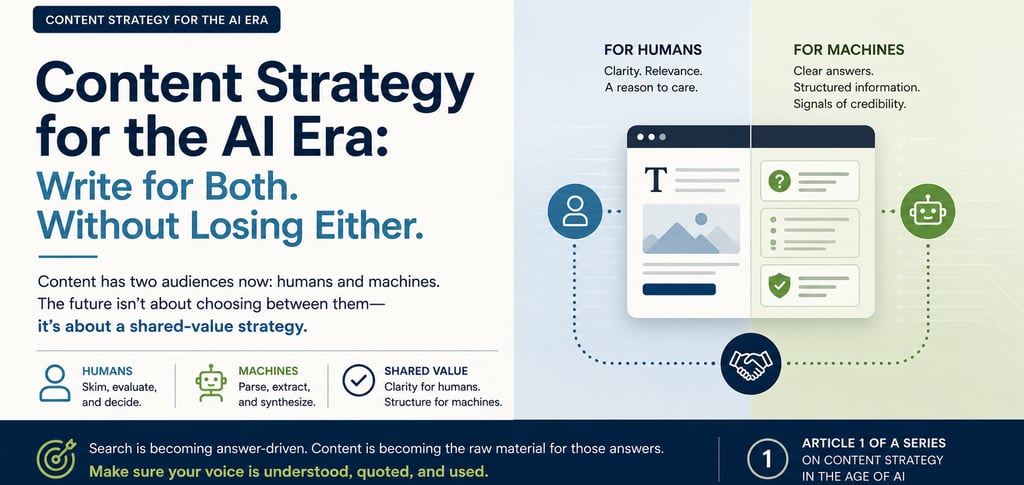
The future of content isn’t about choosing between humans and AI. It’s about writing for both… without losing the focus for either. It used to be written to be read, now it’s written to be used.
For years, content strategy has revolved around a familiar rhythm: understand the audience, map intent, deliver value, drive action. That hasn’t changed.
What has changed is how content gets discovered, interpreted, and presented. We’re no longer writing for a linear experience where a user clicks, reads, and converts. Increasingly, content is:
Summarized before it’s seen
Extracted before it’s read
Restructured before it’s clicked
That shift is what’s driving all the noise around buzzwords like AEO, SGE, and GEO. Underneath the acronyms is a simple reality…
Content Now Has Two Audiences
The first is human: They skim, evaluate, and decide. They want clarity, relevance, and a reason to care. This is where strong messaging, benefit-driven headlines, and narrative flow still matter. Maybe more than ever.
The second is machine: It parses, extracts, and synthesizes. It’s not persuaded by clever phrasing or emotion. It’s looking for clean answers, structured information, and signals of credibility.
The mistake I’m seeing is treating this as an either/or decision. Some teams are over-optimizing for AI, turning everything into question-led, FAQ-style content that reads like it was assembled by a committee of chatbots.
I personally dislike question headers because historically, action/benefit-led headers perform better for conversion BUT, it turns out they’re not as good for extracting information for LLMs.¹
Others are ignoring the shift entirely, producing beautifully written content that’s effectively invisible in environments where answers are generated, not browsed.
How Strategists and Marketers Need to Adapt
The more useful approach is what I think of as a “shared-value” strategy. At the top of the page, you write for humans. Clear value propositions. Strong, benefit-driven headlines. Messaging that drives action.
Within and beneath that, you create structured, extractable moments. Definitions. direct answers. sections that map cleanly to real questions.
You’re not replacing your voice, rather you’re making sure it can be understood, quoted, and reused. Why? Because that’s what’s actually happening. Search engines are becoming answer engines. Interfaces are becoming conversational. And content is increasingly being used as raw material for responses, not just destinations for clicks.
For content strategists and marketers, this doesn’t require becoming an AI engineer.
It requires a subtle shift in mindset:
From writing pages to structuring knowledge.
From optimizing for ranking to optimizing for retrieval.
From telling stories to making meaning easy to extract and repackage.
The fundamentals still apply; good content is still good content. It just has an additional function now.
And teams that balance human clarity with machine structure are not only adapting but also influencing how brands lead in this evolving content creation landscape.
Check out the next article in this series where we look at HOW to structure content for both human and machine readers.
1. Nielsen Norman Group (NN/G) research indicates that benefit-led headings (also known as user-centric or topic-oriented headlines) significantly improve user engagement and conversion by immediately communicating value, reducing cognitive load, and enhancing scanability.