Why "Good" Content Still Fails in the Age of AI
Sharise Cunningham
4/30/20262 min read
Part 2 of Content Strategy in the Age of AI (previously published on LinkedIn). Discusses why even good content still fails in the age of AI.
For years, content strategy has been built around pages: Web pages. Landing pages. Blog posts, etc. We’ve optimized, tested, and measured performance based on how people move through them. But increasingly, content isn’t being consumed as a whole, it’s being pulled apart, summarized, extracted and reassembled before it’s even read.
That shift exposes a gap in how most content is created. Because writing a good page is not the same as structuring usable knowledge.
The Problem Isn’t Quality. It’s Clarity.
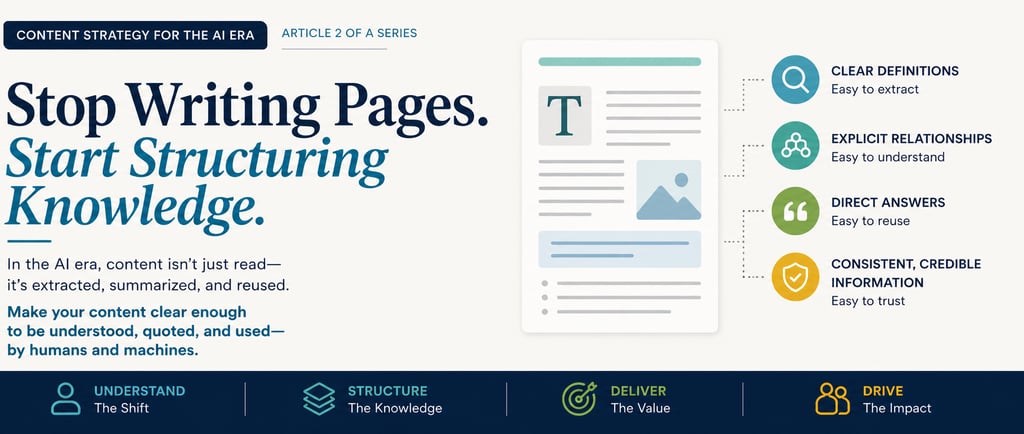
Most content is still written linearly. It includes the textbook beginning, middle, and end; allows the message to unfold over time and is intended to be scrolled. That still works for humans but AI doesn’t experience content that way. Rather it looks for clear definitions, explicit relationships, and statements it can extract and reuse.
Why “Good” Content Still Fails
This is where a lot of otherwise strong content breaks down. Not because it lacks quality, but because it lacks clarity. The main idea is often buried halfway down the page, definitions are implied instead of stated, value is communicated through storytelling instead of direct explanation.
A human might appreciate the narrative, the nuance, and the way a story builds meaning over time. A machine doesn’t. It isn’t following the arc or interpreting intent, it’s scanning for clear, extractable statements it can use.
That doesn’t mean brands should stop telling stories. It means they need to support them. The narrative can still do the work of engaging and persuading, but the key ideas within it need to be made explicit, easy to identify, and able to stand on their own when pulled out of context.
Content has gone from being read to being used. When pieces are extracted separately such as when only a paragraph is surfaced, a sentence is quoted out of context, or an answer is generated without a click you need to ensure it still...
Makes sense
Represents your brand accurately
Delivers value
If not, it’s not structured for how content is now being consumed.
What Needs to Change
As mentioned above, this doesn’t mean abandoning storytelling. It means supporting them with structure. When crafting your content be sure to build-in information that can stand on its own by providing:
Clear definitions: For an AI to synthesize your knowledge base into an SGE overview, your content must clearly define core concepts.
Direct answers: Think of each content component as a direct, standalone answer to a potential user query.
Consistent terminology: Ensure the same terms are used consistently to describe specific entities and relationships throughout your knowledge base.
This is where the “shared-value” strategy starts to take shape in practice. You’re still writing for humans. You’re just making sure your content can also be understood, extracted, and reused without losing meaning.
Pages still matter but they’re no longer the unit of value—understanding is. Content that prioritizes clarity, structure, and meaning gets read (by humans), used (by machines), and ultimately drives impact and value.
Next up we’ll look at Why Good Content Is Still Invisible in AI Search.