Why "Good" Content Is Still Invisible in AI Search
Sharise C.
5/7/20262 min read
Part 3 of a 6-part series on content strategy in the age of AI introduces the distinction between visibility, retrieval, and understanding.
For years, content teams focused on visibility. Rank on page one. Increase impressions. Drive clicks. And for a long time, that made sense because traditional search rewarded discoverability. If users could find your content, you had a chance to persuade them.
But AI-powered search and generative experiences are changing that equation. Visibility alone isn’t enough because content can be technically “visible” and still never become part of the answer.
Visibility Does Not Equal Retrieval
A lot of brands are producing strong content that still fails to appear in AI-generated responses. Not because the content is bad but because it isn’t structured in a way that makes it easy to retrieve, interpret, and reuse.
This is the distinction many teams are missing:
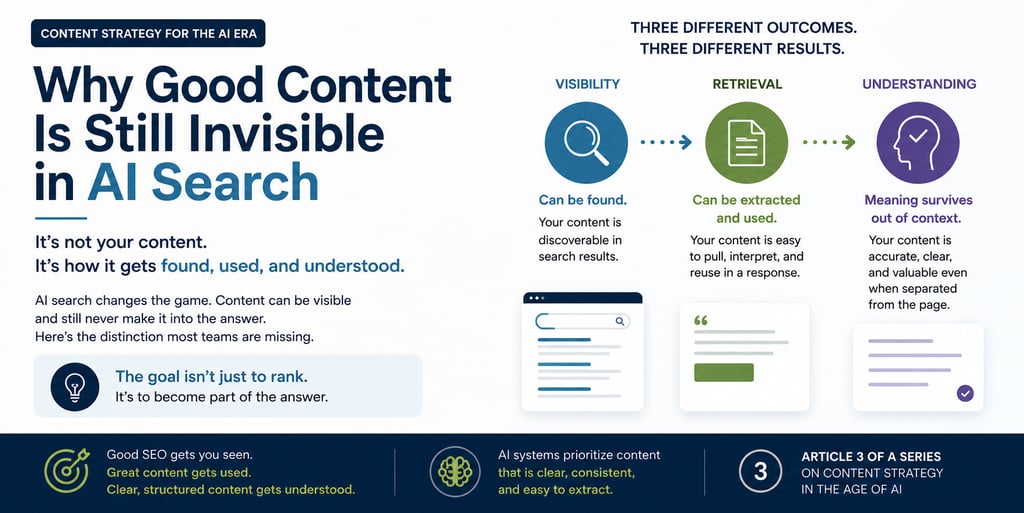
Visibility means your content can be found.
Retrieval means your content can be extracted and used.
Understanding means the meaning survives once it’s pulled out of context.
Those are no longer the same thing.
Traditional SEO Trained Us to Think in Clicks
Historically, search optimization focused on:
rankings
keywords
backlinks
click-through rates
Those signals still matter but increasingly, search engines and LLMs are trying to answer questions directly instead of simply pointing users toward pages. I’ve found that for some reason, those answers – especially within Google search results, turn out to be incorrect more often than traditional searches that provide links to do your own digging.
That means content is often evaluated at the information level, not just the page level. A single paragraph, definition, comparison, or explanation may be surfaced independently from the rest of the article.
Why Otherwise “Good” Content Gets Ignored
A lot of content still assumes readers will:
arrive on the page
read sequentially
absorb context over time
AI systems don’t work that way. They prioritize content that is:
direct
structurally clear
semantically consistent
easy to extract and summarize
This is why vague thought leadership often underperforms in AI search. It may sound smart to humans because humans can infer meaning from tone, storytelling, and context. Machines are less forgiving. A human might appreciate ambiguity, a machine doesn’t.
Retrieval Is Becoming a Competitive Advantage
The brands that perform well in generative search environments are increasingly the ones that make meaning easy to identify. That doesn’t mean reducing everything to robotic FAQ content.
It means building content with:
clear conceptual framing
explicit definitions
organized relationships between ideas
terminology that remains consistent throughout
In other words; content that can survive extraction.
The Real Shift
For years, content strategy focused heavily on getting users to content. Now we also need to think about what happens when content leaves the page.
Because increasingly, your content may appear:
inside AI summaries
in conversational interfaces
in synthesized responses
or embedded into experiences you don’t control
And when that happens, clarity matters more than polish. Structure matters more than volume. Meaning matters more than traffic.
What This Means for Content Teams
This shift doesn’t replace SEO, rather it expands it.
Content teams now need to think beyond:
“Can people find this?”
and start asking:“Can systems understand and accurately reuse this?”
That requires not just optimizing for discovery, but optimizing for retrieval, interpretation, and understanding. In AI search, the goal is no longer just to rank. It’s to become part of the answer. Once upon a time, the focus was to make your content mobile-first. Do we now need to consider AI-first?
Next up we’ll look at why “understanding” may become one of the most important content metrics of the AI era and how it differs from traditional performance indicators like pageviews, clicks, and rankings.
Missed the first two posts? Start at the first one.