Understanding is the New Content Metric
Sharise C.
5/7/20263 min read
Part 4 of a 6-part series on content strategy in the age of AI explores why traditional performance metrics may no longer tell the full story.
Historically, content teams have relied on familiar metrics to measure success:
• pageviews
• clicks
• rankings
• impressions
• engagement rates
And to be fair, those metrics as well as visibility, traffic, and conversion still matter. But increasingly, they only tell part of the story. Because in AI-powered search environments, content can create value without ever generating a click. That changes how we need to think about performance.
We’ve Been Measuring Attention, Not Understanding
Traditional content metrics are largely designed to measure attention.
• Did someone see the content?
• Did they click it?
• Did they spend time on the page?
Those signals tell us content was discovered and consumed but they don’t necessarily tell us whether it was understood. Understanding is becoming increasingly important because AI systems are now interpreting, summarizing, and reusing content at scale.
That means the success of content no longer depends entirely on whether someone visits a page. It also depends on whether the meaning survives once the content is extracted from it.
What “Understanding” Actually Means
When I talk about understanding as a content metric, I’m referring to something relatively simple:
How accurately and consistently your content is interpreted, recalled, and reused across humans and machines.
That interpretation now happens in multiple places:
• AI-generated summaries
• conversational search experiences
• synthesized answers
• knowledge panels
• recommendation systems
• even internal enterprise AI tools
Your content is increasingly being separated from its original design, layout, and context. So can the meaning still hold up?
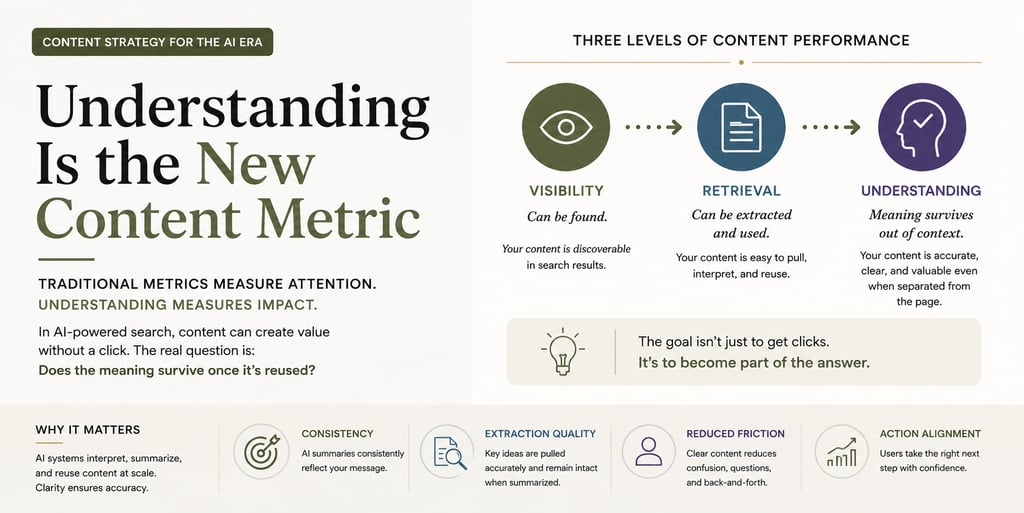
Visibility, Retrieval, and Understanding
In the last article, I introduced the distinction between visibility, retrieval, and understanding.
They’re connected, but they are not interchangeable.
• Visibility means content can be found.
• Retrieval means content can be extracted and surfaced.
• Understanding means the meaning remains accurate and useful after extraction.
This matters because AI systems are not simply linking to pages anymore, they’re actively interpreting information. And interpretation introduces risk.
Content that lacks clarity can be:
• misunderstood
• summarized incorrectly
• stripped of important nuance
• or be reused in ways that distort the original message
Ironically, highly polished content is sometimes the most vulnerable because it prioritizes tone and storytelling over clarity. Humans can infer missing context but as of this writing, machines still struggle with it.
So… How Do You Measure Understanding?
The short answer is, not directly. At least not in the same clean way we measure pageviews or clicks. But understanding leaves footprints.
For example:
1. Consistency Across AI Summaries
Ask multiple AI tools to explain your product, service, or article. Do the responses consistently reflect your intended message or do they vary wildly? Consistency is often a signal that your content is structurally clear and semantically aligned.
2. Extraction Quality
When AI systems surface your content:
• Are they pulling accurate definitions?
• Are key concepts represented correctly?
• Does the meaning survive compression?
If the summarized version feels disconnected from your intended message, the issue may not be visibility, it may be clarity.
3. Reduced Friction
Content that is clearly understood often reduces:
• repetitive support questions
• user confusion
• onboarding friction
• unnecessary back-and-forth
Understanding improves efficiency because people reach clarity faster.
4. Action Alignment
One of the strongest signals of understanding is whether users take the right next action, not just an action.
Do they:
• convert with realistic expectations?
• navigate correctly?
• understand the value proposition?
• engage with the intended offering?
Clicks measure interest. Aligned action often measures understanding, especially if the user is taking the expected path.
The Shift Content Teams Need to Make
Content strategy has focused heavily on discoverability. Now we also need to think about interpretability.
That requires a shift away from optimizing purely for:
• traffic
• rankings
• engagement
and toward optimizing for:
• clarity
• consistency
• semantic meaning
• retrieval quality
• interpretive accuracy
This doesn’t replace traditional metrics, it expands them. Because content performance is no longer limited to what happens on the page itself.
The Real Opportunity
The brands that succeed in AI-driven environments won’t necessarily be the ones producing the most content, or even the “best” content. They’ll be the ones producing the clearest meaning.
Because in the AI era:
• visibility gets you seen
• retrieval gets you surfaced
• but understanding determines whether your content remains accurate, useful, and valuable once it’s reused
Pages still matter. Clicks still matter. But understanding is becoming the metric underneath all of them.
Next up we’ll look at how to audit and adapt existing content for AI-driven search without starting over from scratch (iow, to save time and money).