How to Audit Your Content for AI Search Without Starting Over
Sharise C.
5/28/20262 min read
Part 5 of a 6-part series on content strategy in the age of AI explores how to adapt existing content for AI-driven search without rebuilding your entire content library.
By now, most content teams understand that AI-powered search is changing how information gets discovered, summarized, and reused. The challenge is figuring out what to actually do about it.
The good news? Most organizations don’t need to completely rebuild their content. In many cases, existing content doesn’t need to be rewritten from scratch. It simply needs to become easier to interpret.
Historically, content optimization focused heavily on:
keywords
rankings
readability
conversion flow
Now we also need to think about:
extraction
semantic consistency
interpretability
retrieval quality
That may sound technical, but the practical changes are often surprisingly straightforward.
Start With Your Highest-Value Content
Don’t audit everything at once. Start with content that already matters most to the business:
high-traffic pages
high-conversion pages
cornerstone educational content
product/service pages
frequently referenced resources
In other words, start where understanding has the biggest business impact.
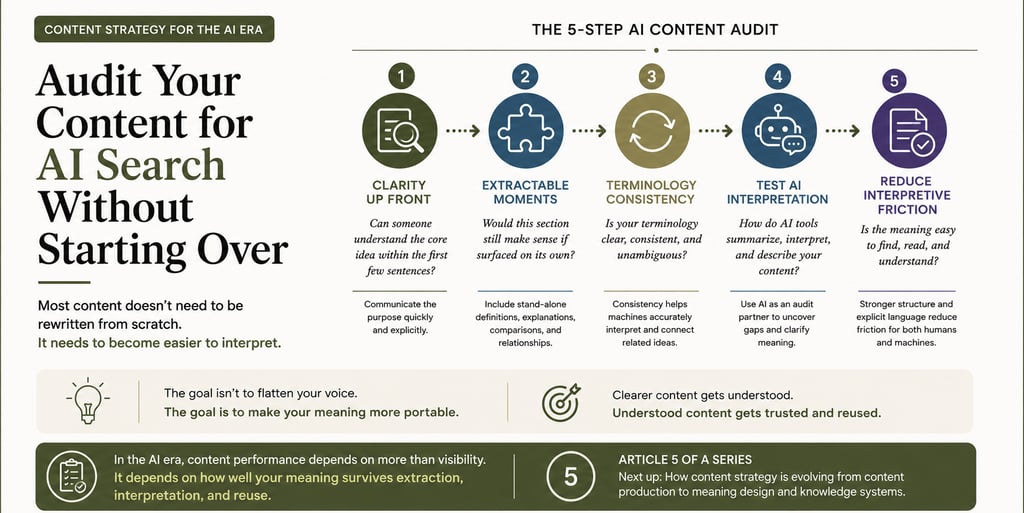
The 5-Step AI Content Audit
1. Check for Clarity Up Front
AI systems prioritize content that communicates its purpose quickly and explicitly. Ensure that the reader can understand the core idea within the first few sentences. This doesn’t mean removing storytelling or personality. It means making the primary meaning easier to identify earlier.
2. Look for Extractable Moments
Increasingly, sections of content may appear independently from the page itself. Your content should contain stand-alone moments:
definitions
concise explanations
structured comparisons
clear relationships between ideas
Ask yourself, if this paragraph appeared independently in an AI-generated response, would it still make sense?
3. Audit Terminology Consistency
Machines struggle when terminology constantly shifts. If your brand alternates between terms like:
customers
users
clients
members
…without clear distinction, interpretation becomes harder. Consistency improves retrieval and semantic understanding.
4. Test How AI Interprets Your Content
Take an existing article and ask multiple AI tools:
“What is this about?”
“Who is this for?”
“Summarize this page.”
“What action should the reader take?”
The gaps are often revealing; AI can become a surprisingly effective clarity audit partner.
5. Reduce Interpretive Friction
AI systems favor content where meaning is explicit. Simple improvements can dramatically improve interpretability:
stronger headers
shorter paragraphs
clearer transitions
explicit definitions
direct statements
This isn’t about flattening your voice; it’s about making your meaning more portable.
The Real Shift
Instead of traditional content audits that focused heavily on:
SEO gaps
outdated information
conversion optimization
content decay
Now they also need to evaluate:
interpretability
semantic clarity
retrieval quality
extraction resilience
That’s not a replacement for traditional content strategy, it’s simply the next evolution of it.
Get Your FREE Full AI Content Audit Guide
This article is a condensed overview of a more detailed AI Content Audit Framework that includes:
a complete audit checklist
AI testing prompts
interpretability review criteria
evaluation worksheets
and practical workflows for auditing existing content
Subscribe and download the full guide - NO SPAM, EVER!
Next up, we’ll wrap up the series by exploring how content strategy itself is evolving from content production into something much closer to meaning design, information architecture, and knowledge systems.